Objects & Craft
Crockery And Cutlery Wear Out In The Dishwasher
Detergent, heat and contact between items cause most of the damage to tableware, which is why pieces fade, dull and chip without ever being dropped.

Tableware rarely fails dramatically. It degrades a little each cycle, and the cumulative effect over years accounts for most of what gets replaced.
Detergents are aggressively alkaline
Dishwasher detergent is formulated to break down fats quickly at temperature, which requires a chemistry far harsher than washing by hand.
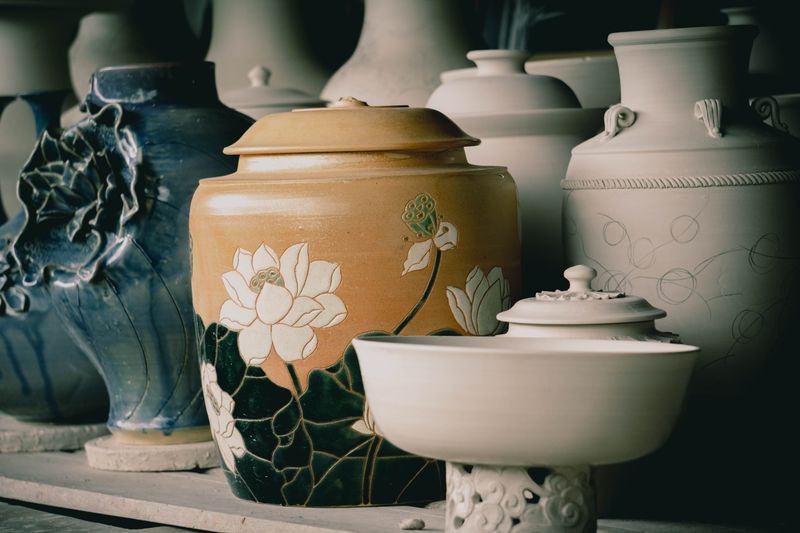
That chemistry attacks decoration applied on top of a glaze, which is why patterns and gold rims fade while the underlying ceramic stays intact.
Decoration applied under the glaze is protected by the glass layer above it and survives indefinitely, which is the difference between the two methods.
Glass is etched rather than dirtied
Cloudiness in older glassware is frequently permanent, caused by the surface being very slightly dissolved over many cycles.
Soft water accelerates it, because the detergent has no hardness to work against and acts on the glass instead.
Once it has happened there is no remedy, which is why the condition is worth recognising before assuming the glasses simply need a better rinse aid.
Contact damage does the rest
Items that touch each other vibrate against their neighbours throughout the cycle, and ceramic against ceramic chips at the rim.
Loading so that pieces are separated does more to extend their life than any choice of detergent.
Cutlery placed handle-down packs more closely but brings the working ends into contact, which dulls knife edges and marks fork tines.
Mixed metals cause visible reactions
Stainless and silver-plated items in contact in a wet, hot, chemically active environment can react, leaving dark marks on the plated piece.
Separating them in the basket avoids it entirely, and plated items generally survive better washed by hand.
Aluminium is a separate case, since alkaline detergent dulls and darkens its surface permanently in a single cycle.
Cast iron and carbon steel lose their seasoning for the same reason, and the exposed metal then begins to rust before the cycle has even finished drying.
Handles and joins are the weak points
Knives with handles bonded to the blade rely on an adhesive that repeated heat cycles will eventually loosen, and the handle then works free.
Full-tang construction, where the metal runs through the handle and is riveted, has no such dependency and outlasts the alternative comfortably.
Hollow handles on cutlery behave similarly, filling with water through a small gap and then discolouring from the inside where nothing can reach.
Checking how a piece is assembled, rather than how it is finished, is the most reliable indicator of how many years of daily washing it will survive.
Questions readers ask
How often should a mattress be replaced?
Commonly quoted figures of seven to ten years come largely from the industry. The practical test is whether you wake comfortable and whether the surface has a permanent hollow.
Is a firmer mattress better for back pain?
Not necessarily; studies have generally found medium-firm to be preferred by more people than very firm. Anyone with persistent back pain should see a clinician rather than choose by rule.