Room by Room
Seating plans are conversation problems, not furniture problems
A living room that nobody wants to sit in usually has its seats too far apart, all facing the same wall.
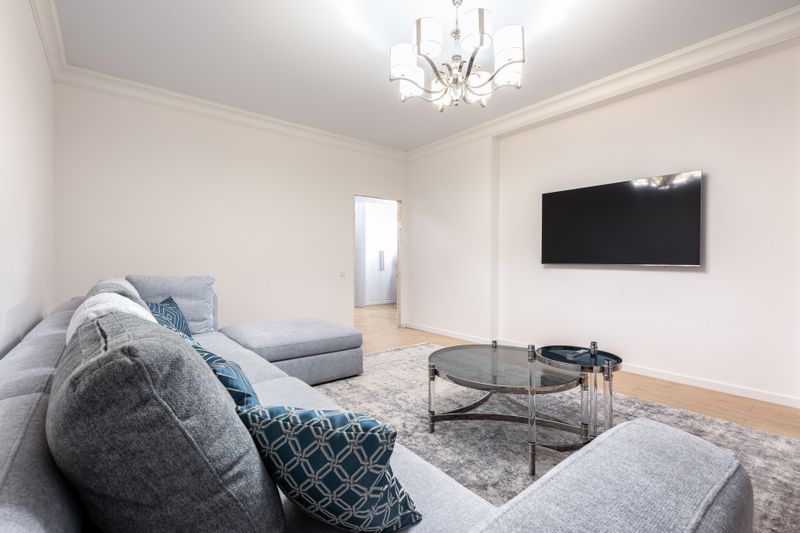
This works through living room seating in the order the parts actually depend on each other.
The short version
- Comfortable conversation happens at roughly two to three metres between faces.
- Seats at an angle to each other are easier to talk across than seats side by side.
- A room with one focal point produces one activity.
Distance decides whether people talk
Conversation at normal volume is comfortable up to about three metres between faces and becomes effortful beyond that. Large rooms furnished by pushing everything to the walls put people four or five metres apart, which is why they feel formal and unused.
Pulling seating into the middle of a big room, with a rug defining the group, fixes this and is usually resisted because it looks odd empty. The room is not for looking at empty, so furnish it for the occupied condition.
Angles beat alignment
Two people on the same sofa cannot see each other without turning, which is why sofas are for sitting beside someone rather than talking to them. An armchair set at roughly forty-five degrees to the sofa creates a natural conversational relationship without anyone having to move. An L-shaped arrangement, or two facing sofas, both work; a row of chairs facing a screen does not.
Most rooms that feel awkward improve by rotating one piece rather than by buying anything.
The screen is not required to be the focus
Arranging everything around a television produces a room with exactly one use, which is a poor return on the largest room in the house. A room can be arranged for conversation and still have a good view of a screen from most seats, since the screen only needs to be visible rather than central. Fireplaces, windows and a good view all work as alternative anchors and are on more of the day than the television is.
Over years, rooms with two arrangements — a conversation group and a reading corner — get used far more hours per week.
Surfaces within reach of every seat
Every seat needs somewhere to put a drink within arm's length, and seats without one are the seats nobody chooses. A side table, a stool or a wide arm all count; a coffee table two metres away does not serve the far chair. Coffee table height around the seat height of the sofa, and roughly four hundred millimetres of clearance to the shins, is the usable range.
This is the single most common reason a chair in a well-furnished room goes unused.
Circulation around the group
People need to reach every seat without stepping over legs, which usually means around six hundred millimetres of route between pieces. A room where the only path runs between the sofa and the fire, or across the front of the screen, generates constant low-level friction.
Marking the seating footprint and the routes on the floor with tape before ordering anything is the cheapest test available. Where the room is genuinely too small for both, a smaller sofa with a clear route beats a larger one without.
Taste is not the argument here; how a room performs is.
Scale is usually wrong in the same direction
People buy sofas too small for large rooms and too deep for small ones, because depth is invisible in a showroom. Seat depth over about six hundred millimetres suits lounging and is uncomfortable for anyone who wants to sit upright with their feet down. Back height determines whether the sofa supports your head, which matters more than the fabric to how long you stay on it.
Room to room, sitting on it for ten minutes, not thirty seconds, is what reveals both.
The takeaway
Move a chair to face the sofa at an angle, give every seat a surface, and stop pushing furniture against the walls.
The best rooms look like a decision, not a purchase.
Questions readers ask
How far should a sofa be from a coffee table?
Around four hundred millimetres — close enough to reach a cup without standing, far enough to get past. Measure it with tape before you buy either.
Can a small living room have two sofas?
Sometimes, and two small sofas facing each other often work better than one large one plus chairs, because they use the walls efficiently and create a conversational axis.