Materials
Lime and cement are not the same mortar, and an old wall knows the difference
Mortar is meant to be the sacrificial part of a wall. Replacing a soft one with a hard one moves the damage into the bricks, where it cannot be repointed away.
This is written to be used rather than admired. Each section below is a decision about mortar and render, and each one has a default.
Before you start
- Mortar should be weaker than the masonry it joins, so that it fails first and can be replaced.
- Lime allows moisture to move through and evaporate from the joint rather than the brick face.
- A hard cement repoint on soft brickwork commonly leads to spalled brick faces.
What mortar is actually for
Mortar spreads load between units that are never perfectly flat, so its first job is to make an irregular stack behave as one wall. Its second job is to be the weakest component, taking up movement and weathering so that the expensive units survive intact. That is why the traditional rule is that mortar should always be softer than the brick or stone it sits between.
A wall built with a mortar harder than its masonry has nowhere soft to fail, so stress and salt damage are pushed into the units themselves. Repointing is normal maintenance precisely because the joint is designed to be the part you renew.
How lime behaves differently
Lime mortar sets slowly and remains comparatively soft and permeable, allowing water vapour to pass through the joint and leave the wall. It tolerates small movements without cracking through, and fine cracks can partially reseal as free lime redeposits over time.
In practice, that permeability is the point in a solid wall with no cavity, because such walls manage water by absorbing and then releasing it. Cement-rich mortar is stronger and sets faster, which suits modern cavity construction where the wall is not expected to breathe through its joints. Neither material is better in general terms; each belongs to a different way of building, and the mismatch is what causes damage.
What goes wrong when the two are mixed
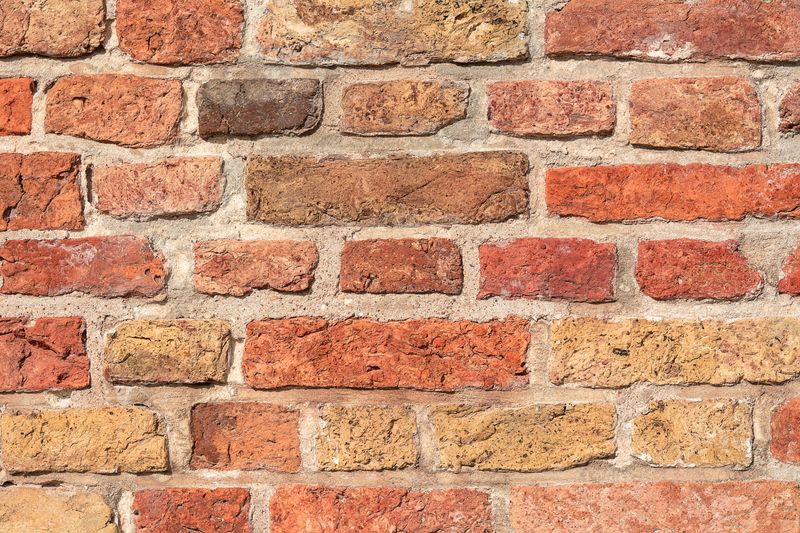
A dense cement joint blocks the evaporation route, so moisture leaves through the face of the brick instead of through the mortar. When that moisture carries dissolved salts, they crystallise just under the brick surface and push the face off in flakes.
Underneath it, freezing does the same thing by a different mechanism, expanding water trapped in a brick that can no longer dry outward. The result is a wall where the pointing is intact and the bricks are eroded, which is expensive and largely irreversible. Because the damage takes seasons to appear, the connection between the repoint and the spalling is often missed entirely.
Render and paint on old walls
The same logic applies to surface coatings: a permeable wall rendered in a dense cement mix traps moisture behind an impermeable skin. Trapped moisture eventually breaks the bond, and the render sounds hollow when tapped long before it visibly cracks or falls. Masonry paints vary enormously in permeability, and a film-forming paint on a solid wall can behave like a thin impermeable render.
Limewash and mineral paints work differently, sitting within the surface and allowing the wall to continue drying outward.
When a wall is described as needing to breathe, this is what is meant: an evaporation route, not a draught.
Reading a joint before touching it
The colour, hardness and texture of the existing mortar tell you a great deal, and a joint that can be scratched with a coin is not a cement one. Joint profile matters too, because a joint struck to shed water performs differently from one that has been raked back into a shadow line.
In practice, pointing proud of the brick face creates a ledge that holds water against the masonry, which is a common and avoidable error. Repointing only the failed areas, matched to what is there, is usually better practice than stripping and redoing a whole elevation. The old mortar has to be removed carefully, because power tools widen joints and damage brick arrises in a way that cannot be hidden.
What photographs well and what lives well are frequently different rooms.
When to get specialist help
Solid-wall buildings, listed or protected buildings and anything with historic fabric are areas where specialist conservation advice pays for itself. Rules covering protected buildings differ substantially between countries and even between local authorities, so check before any work is specified.
Lime work also has practical constraints around temperature and weather during curing that a general builder may not be set up for. Structural cracking is a separate question entirely and belongs to a qualified engineer rather than to a discussion about mortar mixes. If a contractor proposes a cement mix on a soft old wall without discussing why, that is the moment to ask for a second opinion.
The takeaway
Match the new mortar to the wall you have, and keep the joint the softest part of the assembly.
A room that is used will always beat a room that is finished.
Questions readers ask
How can I tell if my mortar is lime or cement?
Lime mortar is usually softer, paler and can often be scratched with a coin or a key, while cement resists. If it is not obvious, get someone experienced with older buildings to look.
Is cement mortar always wrong on an old house?
Not always, but it is frequently a poor match on solid soft-fired brickwork or soft stone. The principle is that the joint should be weaker than what it joins.