Room by Room
A desk in a bedroom needs a boundary you can see
Home working failed for most people at the point where the work never visually stopped.
This is written to be used rather than admired. Each section below is a decision about home working spaces, and each one has a default.
Before you start
- A visible end-of-day state matters more than the size of the desk.
- Screen height and chair height are the two ergonomic decisions that count.
- A window to the side avoids both glare and silhouette.
The problem is that the work never closes
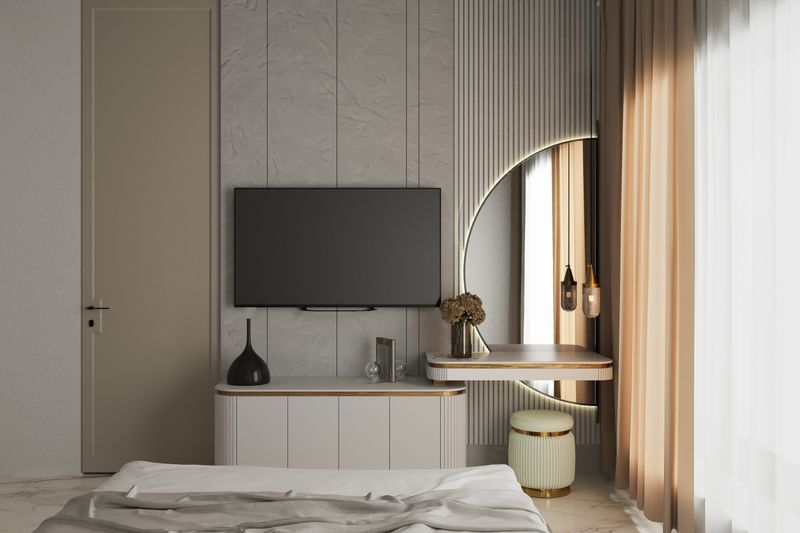
An office in a separate room ends when the door shuts; a desk in a bedroom is visible from the pillow. The practical substitute is a shutdown that changes the appearance of the corner — a lid that closes, a cupboard door, a cover, or simply everything into one box. A bureau or an armoire desk does this by design and is the reason those pieces existed in the first place.
Where none of that is possible, moving the chair away and clearing the surface is a weaker version of the same signal and still helps.
Screen height, then chair height
The top of the screen at roughly eye level puts the neck in a neutral position, which is why laptop users need either a stand or an external screen. A laptop on a table forces you to choose between a bent neck and raised arms, and a fifteen-pound stand plus a separate keyboard removes the choice. The chair should let your feet rest flat with thighs roughly horizontal, which for shorter people usually means a footrest rather than a lower chair.
Room to room, these two adjustments account for most of the difference between comfortable and painful home working setups.
Where the window goes relative to the desk
A window behind the screen puts a bright source directly behind what you are looking at, which is fatiguing and washes out the display. A window behind you reflects on the screen and, on video calls, lights the wall rather than your face.
Underneath it, a window to the side gives good working light without either problem and is the arrangement to aim for. A desk lamp with an asymmetric or adjustable head lights the desk without lighting the screen, which is the second half of the same problem.
Sound is what colleagues actually notice
Microphone quality and room acoustics affect how you are perceived on calls far more than camera quality does. A small hard-surfaced room produces echo, and a rug, a curtain and a bookshelf reduce it noticeably for no cost. A headset with a boom microphone outperforms almost any laptop microphone because it is close to the mouth rather than close to the fan.
Placing the desk away from a shared wall or a street window solves problems that no equipment will.
Cables and power decide whether it stays tidy
A desk with no power near it accumulates a permanent trailing extension lead, which is both a trip hazard and the reason it never looks finished. One socket in the right place, or a clamped power module on the desk edge, resolves most of it.
In practice, any new fixed wiring is work for a qualified electrician, and in many countries it must comply with regulations and be certified. A tray or channel under the desk holding the power supply and the slack is a twenty-minute job that changes how the corner reads permanently.
Shared rooms need scheduling more than furniture
Two people working in one home is a timetable problem: calls that overlap cannot be solved by better shelving. A simple agreement about who takes calls in which room, at which hours, resolves more friction than any layout change. A second, minimal working position — a kitchen table with a stand stored nearby — is worth setting up as a release valve.
Households that never negotiate this tend to conclude the flat is too small when the schedule is the constraint.
The takeaway
Raise the screen, put the window to your side, and give the work a way to visibly close.
A room that is used will always beat a room that is finished.
Questions readers ask
Is a standing desk better?
Alternating between sitting and standing is generally better than either alone. The benefit comes from changing position through the day rather than from standing continuously.
How small can a usable desk be?
Around 1.2 metres wide by 600 deep is comfortable for a screen and keyboard. Below 800 wide you are working on a shelf, which is fine for an hour and not for a day.