Room by Room
The television has quietly rearranged the living room
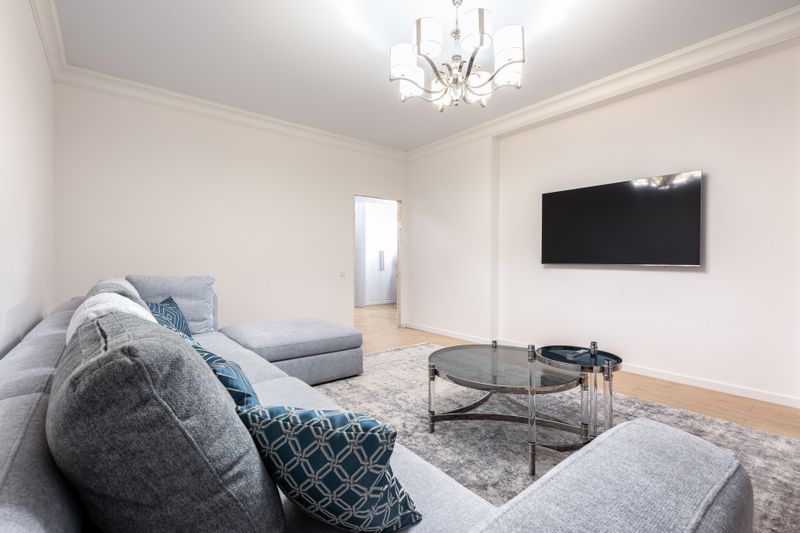
Screens grew, thinned and cheapened, and living rooms reorganised themselves without anyone consciously deciding to. What follows is a set of geometry problems about angle, height and distance.
What follows is the working version of television placement: the decisions in the order you actually meet them, with the reasoning attached.
Before you start
- A room with a fireplace and a screen has two focal points and the seating serves neither well.
- Screen height is judged from seated eye level, not from the wall it hangs on.
- Most reflection problems are solved by moving the screen relative to the window, not by curtains.
Two focal points pulling in different directions
A hearth and a screen on different walls ask the seating to face two ways at once, and the compromise usually satisfies neither activity. Rooms that resolve this cleanly tend to accept one primary focus and treat the other as something you turn towards occasionally. An L-shaped arrangement gives one leg to the screen and one to the fire, which works because people move seats rather than heads.
The alternative is honesty: if nobody lights the fire, the screen wins, and pretending otherwise produces a sofa placed for a photograph. Swivel chairs solve more of this than any layout trick, because they let one seat serve two orientations without moving furniture.
Distance and screen size are the same question
The comfortable viewing distance follows from how much of your field of view the picture fills, so a larger screen simply wants to be further away. Sitting too close to a large panel forces the eyes to travel across the image, which is tiring during a long film in a way nobody attributes to the screen. Sitting too far away wastes the resolution entirely, and detail that cannot be resolved at that distance is detail you paid for and cannot see.
The room usually fixes the distance first, because sofa positions are constrained by doors, radiators and circulation routes. Measuring the actual seat-to-wall distance before choosing a size is the step that turns a guess into a decision.
Height, neck angle and the fireplace problem
The centre of a screen sits most comfortably at or slightly below seated eye level, which is considerably lower than most people mount it. Above a fireplace is the most common mounting position and one of the worst, because it forces the head back for the length of a film.
Chimney breasts also carry heat and, in older houses, may be structurally awkward to fix into, so the fixing is worth checking properly. Low furniture under a screen reads better partly because it drops the whole assembly into the natural sightline of a seated person. A tilting bracket only corrects the picture angle; it does nothing for the neck that is still tipped back to look upward.
Daylight, reflection and the black mirror
A screen facing a window becomes a mirror during the day, and no picture setting compensates for a reflection landing directly on the panel. Placing the screen on the same wall as the window, or perpendicular to it, removes most reflections without darkening the room.
Underneath it, matte panels scatter reflections into a general haze rather than a sharp image, which trades one problem for slightly reduced contrast. A room used for viewing in the evening has a different reflection problem, because lamps behind the viewer land on the screen instead.
A dim light behind the screen reduces the contrast between a bright picture and a dark wall, which is easier on the eyes over hours.
Sound is the half that gets ignored
Thin panels have no internal volume for speakers, so the sound comes from a small driver often firing downward or backward into the wall. Dialogue intelligibility suffers first, which is why people reach for subtitles in rooms with hard floors and little soft furnishing. A rug, curtains and an upholstered seat do more for speech clarity in a living room than most equipment upgrades.
A separate speaker placed under the screen puts the sound at the same height as the picture, which matters more than the number of channels. In a flat, sound travels through the structure rather than the air, so bass carried into a neighbour is a placement problem as much as a volume one.
What photographs well and what lives well are frequently different rooms.
Hiding it, or deciding not to
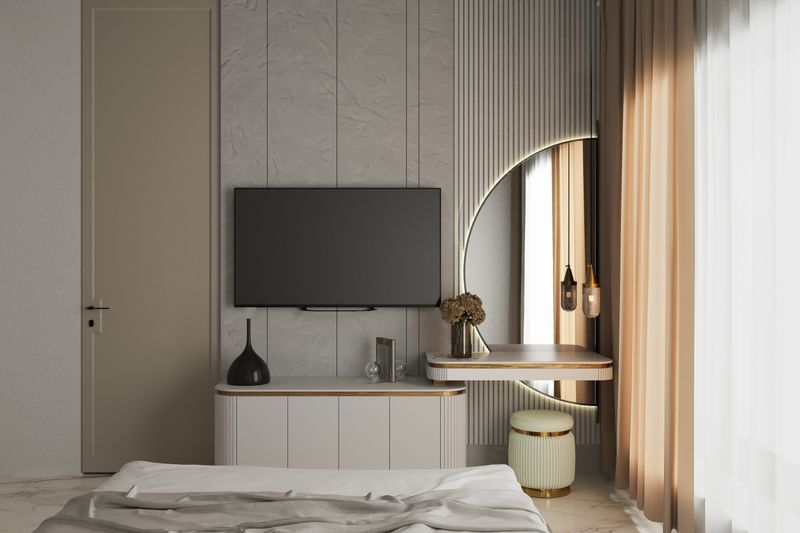
Cabinets and panels that conceal a screen work when they are used daily and become an irritation when the mechanism is slow. Cable management is the more honest fix, because a tangle of leads is usually what makes an arrangement look temporary. A recess or a run of shelving lets a dark rectangle sit among other dark rectangles instead of dominating a pale wall.
Painting the wall behind the screen a deeper colour reduces the contrast that makes the panel read as an object stuck onto the room. The most settled rooms tend to admit the screen is furniture and place it as deliberately as they would a table.
The takeaway
Fix the seat first, then the distance, then the height, and treat the screen as furniture rather than an intrusion.
The best rooms look like a decision, not a purchase.
Questions readers ask
How high should a wall-mounted screen be?
Aim for the middle of the picture at or just below eye level when you are sitting in your usual seat. Measure it from the chair rather than working from the wall.
Does a soundbar really make that much difference?
For speech clarity, usually yes, because a flat panel has almost no cabinet volume for its speakers. Soft furnishings in the room help as much again.