Light
Curtains and blinds are light control before they are decoration
Almost every complaint about a window treatment is a complaint about what it does to daylight, privacy or heat.

What follows is the working version of window treatments: the decisions in the order you actually meet them, with the reasoning attached.
Before you start
- Stack-back position determines how much daylight a curtain blocks when open.
- Lined and interlined curtains measurably reduce heat loss through glazing.
- Privacy and daylight often need two separate layers.
Where the curtain sits when open
A curtain drawn back still covers part of the window unless the pole extends beyond the reveal, and that lost strip is daylight you paid for. Extending the pole two hundred to three hundred millimetres each side lets the fabric stack against the wall instead of the glass.
Hanging the pole higher than the window head and letting the curtain drop to the floor makes the window read as taller and increases the light admitted. These two adjustments cost nothing at the point of installation and are almost impossible to fix later without redrilling.
Two problems, often two layers
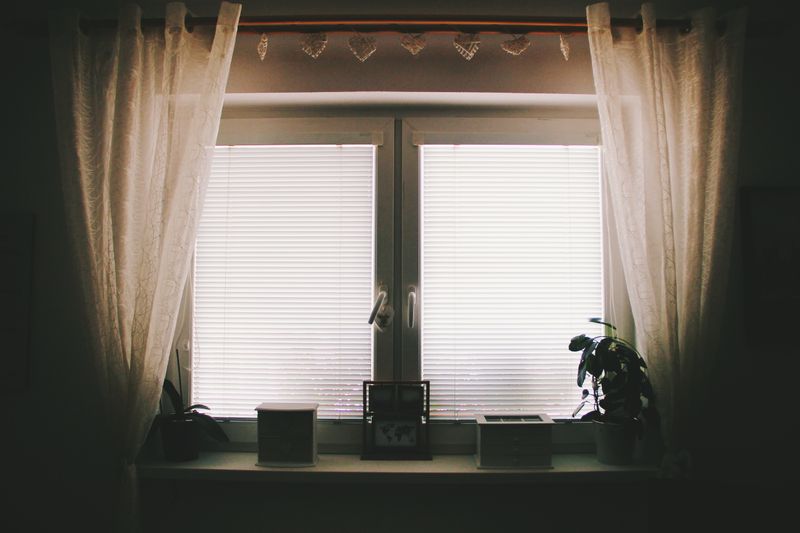
Daytime privacy and night-time darkness are different requirements, and a single opaque curtain cannot do both without blocking the day. A sheer, a café curtain or a light-filtering blind handles daytime overlooking while keeping the room bright.
A heavy curtain or blackout blind then handles evening privacy, darkness and heat loss. Rooms that are permanently gloomy because the only privacy option is a closed curtain are extremely common and entirely solvable.
Thermal performance is real and measurable
Glass is the weakest thermal element in most walls, and a lined and interlined curtain, closed at dusk, reduces the heat lost through it noticeably. The seal matters as much as the fabric: a curtain that hangs to the floor, overlaps at the centre and sits close to the wall traps a still air layer. A curtain hanging in front of a radiator sends that heat up the window instead of into the room, which is a very common arrangement.
A pelmet or a curtain fixed at the top closes the gap where warm air otherwise pours down behind the fabric.
Blind types do different jobs
Roller blinds are cheap, take almost no space and are all-or-nothing on light. Venetian and shutter slats redirect light upward onto the ceiling while blocking the direct view in, which is the only way to have privacy and daylight simultaneously. Roman blinds behave like fabric and have most of the softness of a curtain in a fraction of the depth, which suits shallow reveals.
Honeycomb blinds trap air in cells and are the best thermal performer of the blind types.
Fitting inside or outside the reveal
Inside the reveal keeps the window architecture visible and loses a little light at the edges where the blind sits. Outside the reveal covers the frame, blocks more edge light and gives a better seal for darkness and heat. For a bedroom needing genuine darkness, an outside-fitted blind, or an inside blind with side channels, is what actually stops the light leak.
In practice, measuring for one and ordering the other is the most common and least recoverable mistake in made-to-measure ordering.
What photographs well and what lives well are frequently different rooms.
Practicalities that decide satisfaction
Fabric hung across a window fades along the fold line facing the glass, so linings protect the face fabric as well as adding weight. Weight is what makes a curtain hang well, which is why a cheap fabric with a proper lining often looks better than an expensive one without. Corded blinds are a strangulation hazard around young children and cordless or tensioned options are the safer choice.
In a rental, tension rods and pressure-fit blinds provide most of this without a single hole.
The takeaway
Hang the pole high and wide, use two layers if you need privacy by day, and let the fabric reach the floor.
The best rooms look like a decision, not a purchase.
Questions readers ask
Do curtains really save heat?
They reduce heat loss through the glazing when closed and well sealed at top, sides and bottom. They are not a substitute for double glazing but the effect at dusk in an older house is noticeable.
Should curtains touch the floor?
For thermal performance and appearance, yes — just skimming or slightly breaking. Short curtains leave a gap that both looks unfinished and lets a convection current run.