Light
Task light has to come from the right angle or it does nothing
Reading, chopping and working each need light from a different direction, and the fitting matters less than where it is.
Both approaches to task lighting work. What differs is what they cost you, and the cost is what this sets out.
The difference in one place
- Light from behind and to the side avoids your own shadow.
- A closer light is far more effective than a brighter distant one.
- The contrast between task and surroundings should be moderate, not extreme.
Your own body is the obstacle
Light from directly overhead or in front puts your head and hands between the source and the work, which is why an overhead kitchen light casts a shadow exactly where you are chopping. Light arriving from behind and slightly to one side, over the shoulder opposite your writing hand, clears the shadow. This is the same principle that makes under-cabinet lighting so effective: the source is between you and the wall, below eye level, aimed at the surface.
Getting the angle right usually matters more than doubling the output.
Distance beats brightness
Light falls off sharply with distance, so halving the gap between lamp and page delivers roughly four times the illumination on it. A modest adjustable lamp at forty centimetres outperforms a powerful ceiling fitting three metres up, at a fraction of the energy.
The quieter point is that this is why the lamp needs to be movable and why fixed decorative lamps often fail as reading lights. An adjustable arm is the single most useful feature in a task lamp and the one most often traded away for appearance.
Contrast has to be managed
A bright pool of light in a dark room forces the eye to adapt every time you look up, which is fatiguing over hours. A dim general light in the room, roughly a fraction of the task level rather than a tiny fraction, removes that.
In practice, this is the argument against working with only a desk lamp on, and equally the argument against lighting the whole room to task level. The comfortable arrangement is a lit surroundings with a brighter working area, not one or the other.
Reading in a chair
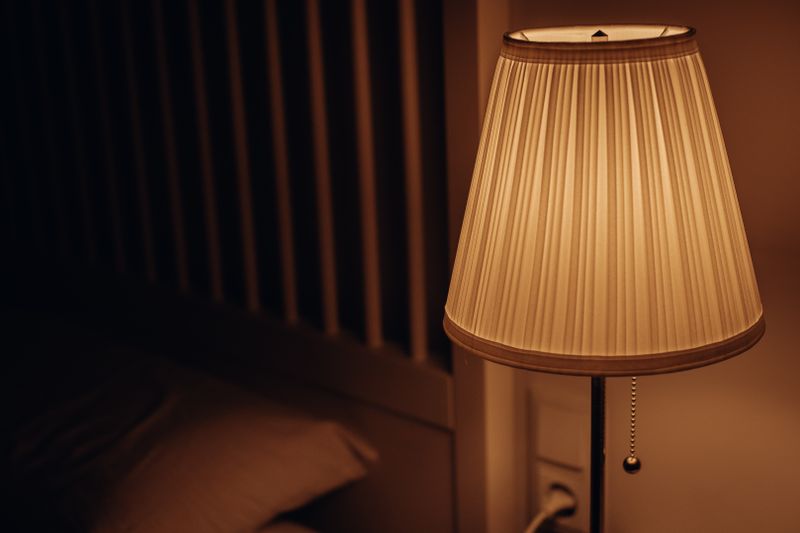
A reading light should sit behind the shoulder at roughly head height when seated, aimed at the page rather than the room. A floor lamp with an adjustable head, or a swing-arm wall light beside the chair, both achieve this and take no table space. A tall lamp with an open-topped shade lights the ceiling and the room but often not the book, which is why the reading corner still feels dim.
For anyone whose eyesight is changing, more light on the page is frequently more effective than a change in reading glasses, though that is a question for an optometrist.
Kitchen surfaces
Every metre of worktop used for preparation needs its own light source under the cabinet above it, and the strip should sit towards the front edge of the cabinet. Placing it at the back throws light up the splashback and leaves the front of the worktop, where you actually work, in shadow. A diffused strip is more comfortable than exposed points, which reflect as a row of bright spots in a glossy worktop.
A high CRI here changes how food and ingredients look and is worth specifying deliberately.
Mirrors and close work
Light for a face needs to come from both sides at roughly face height, which is why theatre mirrors are lit that way and bathroom downlights are not. A single light above a mirror casts shadows into the eye sockets and under the nose and chin. For sewing, model-making or anything with fine detail, a lamp with a wide even beam and high colour rendering reduces strain more than raw output does.
Room to room, magnifying lamps combine both and are worth the awkwardness for sustained close work.
Side by side
| Consideration | What it means in practice |
|---|---|
| Your own body is the obstacle | Light from behind and to the side avoids your own shadow. |
| Distance beats brightness | A closer light is far more effective than a brighter distant one. |
| Contrast has to be managed | The contrast between task and surroundings should be moderate, not extreme. |
The takeaway
Put the source behind your shoulder or under the cupboard, get it close, and keep some light in the rest of the room.
Buy slowly. The gaps are not a problem.
Questions readers ask
How bright should a desk lamp be?
Enough that you are not squinting, with the room around it moderately lit. Adjustability matters more than a specific figure, because the requirement changes with the task and the time of day.
Why does my kitchen light cast a shadow on the worktop?
Because the light is behind you and you are between it and the surface. Under-cabinet lighting solves it, because the source is in front of you and below eye level.