Light
Most room problems are lighting problems
A room that feels wrong and cannot be diagnosed is almost always lit from one place, at one colour, at one level.

What follows is the working version of lighting a room: the decisions in the order you actually meet them, with the reasoning attached.
Before you start
- Three or more sources at different heights beat any single fitting.
- Colour temperature should shift warmer through the evening.
- Light on the walls makes a room feel larger than light on the floor.
One source is the fault
A single ceiling pendant produces flat overhead illumination with no shadow variation, which is the visual signature of a corridor rather than a living space. It also puts the brightest point above eye level, which is glaring and unlike any natural condition. Adding two lamps at different heights transforms a room more cheaply than any other intervention.
This is the single most common and most easily fixed interiors problem in ordinary homes.
Light the walls, not the floor
Vertical surfaces are what the eye reads as the boundary of a space, and lighting them makes a room feel larger. Downlights pointed at the floor light the least useful surface and leave the walls dark, which shrinks the room.
Wall lights, uplighters and lamps with open shades all direct light where it does the most for perceived size. How much this achieves depends on what the wall is made of, since a pale matt surface returns most of the light back into the room while a dark or heavily textured one absorbs it, which is why an uplighter that transforms a white room can look almost switched off in a deep green one.
Colour temperature should move
Cooler light supports alertness and suits daytime and task areas; warmer light suits evenings. Fixing a room at one temperature means it is wrong for half the day.
Warm dimming bulbs, which shift warmer as they dim, reproduce the behaviour of the incandescent lamps people remember fondly. Mixing temperatures inside one room is the more visible error, because the eye adapts to whichever source dominates and everything lit by the others then reads as blue or as yellow, which is how a single replacement bulb from a different pack makes an entire room look wrong.
Dimming is the upgrade that matters
Being able to lower output through the evening tracks the natural decline in daylight and does more for atmosphere than any fitting. Compatibility between dimmer and bulb determines whether it works; mismatches cause flicker and dropout at low levels. Where wiring cannot change, plug-in dimmable lamps and smart bulbs achieve most of it.
Trailing-edge dimmers generally suit LEDs where older leading-edge ones do not, and many dimmers carry a minimum load that a single low-wattage LED cannot meet, which is why one bulb on a circuit flickers while four on the same dimmer behave — and in most countries altering a wired dimmer is work for a qualified electrician.
Render colour properly
Colour rendering index describes how accurately a light source shows colour, and cheap sources often score poorly. Low-quality light makes skin, food and paint colours look wrong in a way people notice without identifying.
A figure above ninety is worth looking for in any room where you eat, cook, dress or look at people. The figure is an average across a set of test colours and it hides a known weakness at deep red, so two sources quoting the same number can render skin and food noticeably differently, and a manufacturer who publishes no figure at all has told you something.
Budgets and buildings differ, and old buildings differ most.
You should see lit surfaces, not bulbs
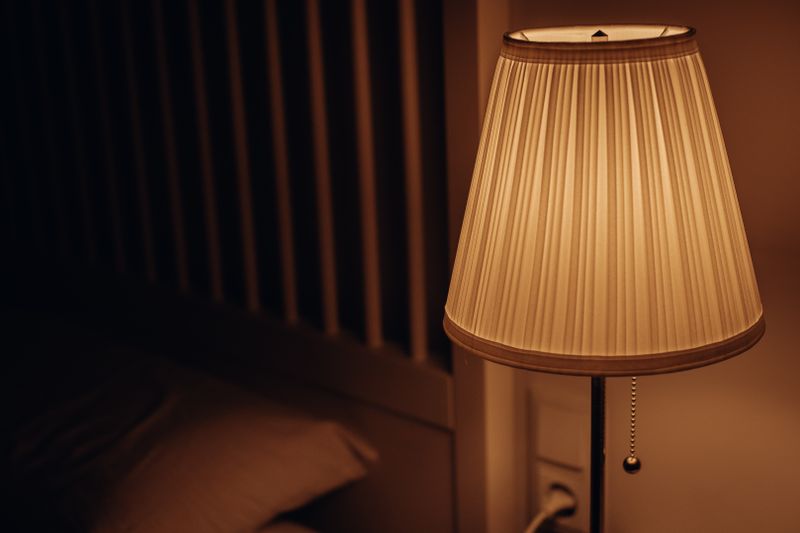
Glare is a contrast problem rather than a brightness problem: a bare bulb at eye level is painful in a dark room and barely registers in a bright one, at identical output. That is why an exposed filament bulb hung at head height over a dining table is the fitting people most often come to regret, and why the same bulb inside a shade causes nobody any trouble. Shades, deep recesses and light aimed at a wall or ceiling all work the same way, by removing the bright source from the direct line of sight while leaving the light in the room.
Underneath it, testing this means sitting where you actually sit — on the sofa, at the table, in bed — and looking around at eye level, because glare only exists from a particular position and a standing survey of the room will miss it.
The takeaway
Turn the big light off, add two lamps and put light on the walls.
The best rooms look like a decision, not a purchase.
Questions readers ask
How many lamps does a living room need?
Three light sources at different heights is a good working minimum, with at least one that can be dimmed. Four or five is not excessive in a large room.
Are downlights a mistake?
Not inherently, but a grid of them as the only lighting is. Used to light specific surfaces, alongside lamps and wall lights, they work well.