Light
Lighting the things you want people to look at
Most homes light rooms and then wonder why nothing in them stands out. Lighting an object is a different discipline with its own angles and its own risks to the object.
The points below about lighting pictures and objects are ordered by how much difference they make, not by how often they get repeated.
What matters most
- Light aimed at roughly thirty degrees from vertical lights a picture without reflecting into the viewer.
- Ultraviolet and visible light both fade pigments and textiles cumulatively and irreversibly.
- Heat from a close fitting damages what it is lighting.
Angle decides whether you see the work or the glare
A picture lit from directly above throws a shadow from its own frame across the top of the image. Lit from too far in front, the light reflects off the surface straight back into the eye of anyone standing in front of it.
The conventional compromise is an angle of roughly thirty degrees from vertical, which clears the frame and directs reflections away from the viewer. Glazed pictures make this stricter, because glass reflects the source as a bright rectangle from most other positions. Non-reflective glazing helps considerably, and it is one of the few cases where the framing solves a lighting problem.
Objects need different treatment from pictures
A three-dimensional object needs light from more than one direction, or it becomes a silhouette with one bright face. A main light plus a weaker fill from the opposite side keeps the form readable while retaining enough shadow to describe it. Lighting glass and ceramics from behind or below reveals translucency that front lighting flattens completely.
Live with it a while and small integrated lights within a cabinet keep the source out of view, which matters because a visible bulb dominates any display. Shelf-mounted lights should be positioned so the beam falls on the object rather than on the shelf edge above it.
Beam width and the neatness of the pool
A narrow beam picks out a single object and leaves a dark surround, which reads as deliberate and slightly theatrical. A wider beam covers a group but spills onto the surrounding wall, which is more forgiving and less precise.
Matching beam width to the size of the object at that distance is what produces a clean pool of light rather than a smear. Adjustable fittings are worth the extra cost because objects move and pictures get rehung far more often than fittings do. A framing attachment shapes the beam exactly to a picture, which is a professional technique that is dramatic and unforgiving of any error.
Light damages what it illuminates
Fading is cumulative and irreversible: the total dose of light over years determines the damage, not the brightness at any moment. Watercolours, textiles, photographs, paper and many dyes are the most vulnerable, and some pigments shift colour rather than simply paling. Ultraviolet light is the most damaging portion, which is why daylight is far harder on a work than lamplight of similar apparent brightness.
Live with it a while and modern light sources emit little ultraviolet compared with older lamp types, but visible light still causes fading over time. Museums keep valuable works at low light levels and rotate them out of display, which is the principle behind not hanging anything precious opposite a window.
Heat and proximity
A fitting mounted close to a canvas or a textile creates a warm zone, and repeated heating and cooling stresses the material. Picture lights fixed to a frame put the heat source at its closest possible distance, which is a reason to keep them modest. Enclosed display cabinets accumulate heat, and a sealed case with lamps inside can reach temperatures that damage what it protects.
Live with it a while and ventilating a cabinet, or mounting the light source outside it, removes the problem entirely. For anything genuinely valuable, conservation advice differs by material and is worth obtaining from a specialist rather than guessed at.
Simple approaches that work
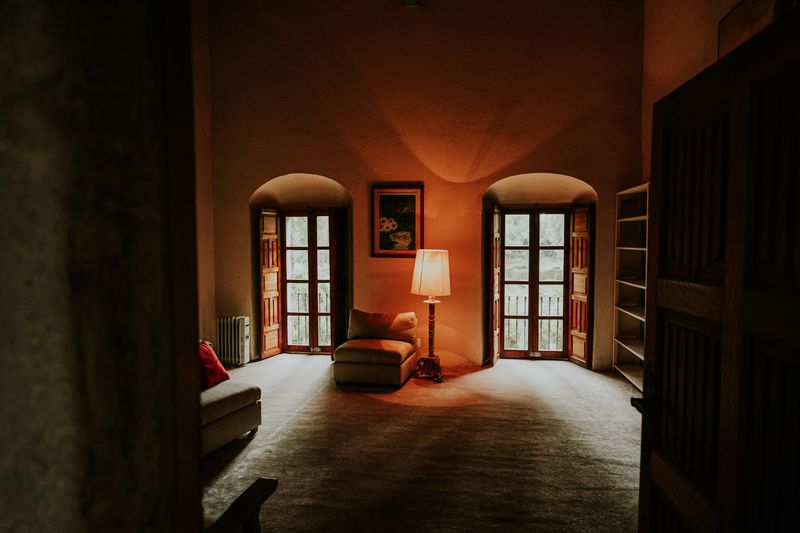
A single well-aimed adjustable spot on a track can light three or four things and be redirected whenever they change. A floor uplighter placed behind a plant projects its shape onto the ceiling and lights the room indirectly at the same time. Lighting a doorway, an archway or the far end of a hall pulls people through the house and gives the eye a destination.
In practice, a lamp placed to graze a textured wall hanging shows its weave in a way that flat frontal light cannot. The general rule is to light fewer things better, since a room where everything is accented has no accent at all.
Everything above, in order of what to do first
- Angle decides whether you see the work or the glare. A picture lit from directly above throws a shadow from its own frame across the top of the image.
- Objects need different treatment from pictures. A three-dimensional object needs light from more than one direction, or it becomes a silhouette with one bright face.
- Beam width and the neatness of the pool. A narrow beam picks out a single object and leaves a dark surround, which reads as deliberate and slightly theatrical.
- Light damages what it illuminates. Fading is cumulative and irreversible: the total dose of light over years determines the damage, not the brightness at any moment.
- Heat and proximity. A fitting mounted close to a canvas or a textile creates a warm zone, and repeated heating and cooling stresses the material.
- Simple approaches that work. A single well-aimed adjustable spot on a track can light three or four things and be redirected whenever they change.
The takeaway
Light fewer things, get the angle right, and keep the source far enough away that it is not cooking what it shows.
Buy slowly. The gaps are not a problem.
Questions readers ask
What angle should a picture light be at?
Around thirty degrees from vertical is the usual starting point. Steeper causes frame shadow, shallower reflects the source back at the viewer, especially with glazing.
Will lighting damage my prints?
Light damage is cumulative, so what matters is total exposure over years. Keep works on paper away from direct daylight, keep levels modest and rotate anything precious.