Light
The shade changes the room more than the lamp does
Two identical bulbs in two shades produce completely different rooms, because the shade decides where the light goes.
There is a short answer about lampshades and a useful one, and they are not the same. What follows is the useful one.
The short version
- Opaque shades direct light up and down; translucent ones glow and light the room.
- Lining colour tints the light that passes through.
- Shade size and position determine whether the bulb is visible when seated.
Opaque versus translucent is the primary choice
A card or metal shade blocks light sideways and pushes it up and down in two cones, producing pools rather than general illumination. A fabric or paper shade transmits light through its surface, so the shade itself becomes a soft glowing object and lights the room broadly. The first is what you want beside a chair for reading; the second is what you want for ambience across a room.
Choosing the wrong one is why an expensive lamp can fail to light anything, and it is a shade problem rather than a bulb problem.
Lining colour tints everything
A shade lined in white transmits and reflects light neutrally; one lined in gold or copper warms it noticeably. A black-lined shade absorbs most of the internal reflection and gives a very directed, dramatic light with little room glow.
The quieter point is that this is why two identical outer fabrics can produce very different light, and the lining is rarely mentioned in a description. For a dining pendant, an opaque outer with a reflective warm lining puts a flattering light on the table and nothing in anyone's eyes.
Geometry decides whether you see the bulb
From a seated position, if you can see the lamp through the bottom of the shade, it will glare every time you look that way. A shade needs to be deep enough, or the bulb high enough within it, that the source is concealed from normal sitting eye level. For a pendant over a table, this means an opaque or baffled bottom, or hanging it low enough that the source is below eye height.
Over years, sitting in each seat and looking at the fitting is the check that takes thirty seconds and is almost never done in a shop.
Proportion and the standard guides
A shade that is roughly two-thirds the height of the lamp base, and wider than the widest part of the base, usually looks right. The bottom of the shade should conceal the fitting and the top of the base neck, which is the detail that reads as cheap when it fails. Drum shades give a broad even wash; empire and cone shapes throw more downward and read more traditional.
These are conventions rather than rules, but breaking them tends to look like an error rather than a decision.
Material behaviour
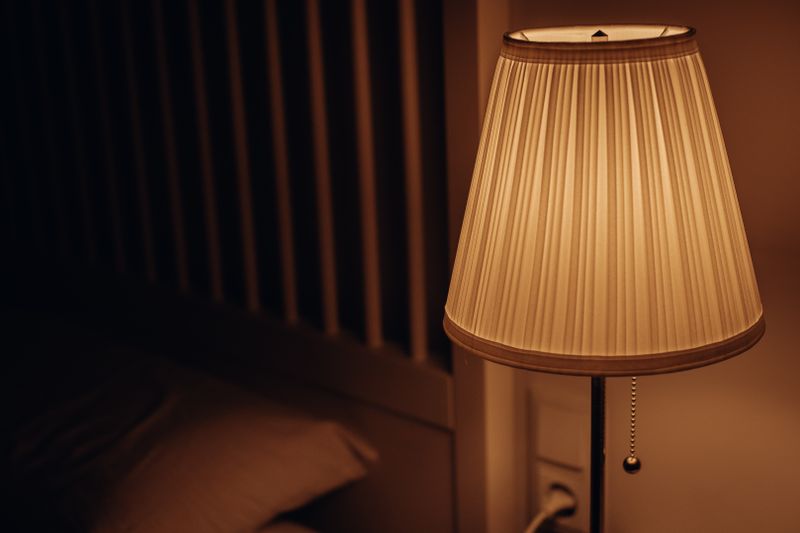
Linen and cotton diffuse warmly and slightly soften colour; parchment and paper glow strongly and cast a warm tint. Silk transmits beautifully and degrades in sunlight; pleated shades scatter light in a way that hides the bulb well. Metal and glass shades create sharp-edged pools and reflections, which suits task positions and reads harder in a living room.
Live with it a while and rattan, woven and perforated shades throw pattern onto walls and ceilings, which is a feature at low output and a distraction at high.
Heat and safety
Shades are marked with a maximum wattage, and that limit is about heat rather than brightness, which is why LEDs have relaxed it in practice. Old shades and vintage fittings can have perished insulation and fabrics that were never intended to sit near a hot lamp. Any rewiring of an old lamp should be done by someone competent, and in many countries a portable appliance can be checked cheaply.
Room to room, a lamp that gets hot enough to smell should be switched off and inspected rather than tolerated.
The takeaway
Decide whether you want a pool of light or a glowing object, then buy the shade that does that.
A room that is used will always beat a room that is finished.
Questions readers ask
What size shade for my lamp?
Roughly two-thirds the height of the base and wider than its widest point, deep enough to hide the fitting. Take the base to the shop if you can, because proportion is much easier to judge in person.
Why is my lamp so dim?
Often the shade rather than the bulb. An opaque shade sends all its light up and down, so the room stays dark even with a bright lamp. A translucent shade will light the space.