Small Spaces
Doors take up more room than anybody counts
Every hinged door claims a quarter circle of floor permanently, and in a small home those circles add up to a room.
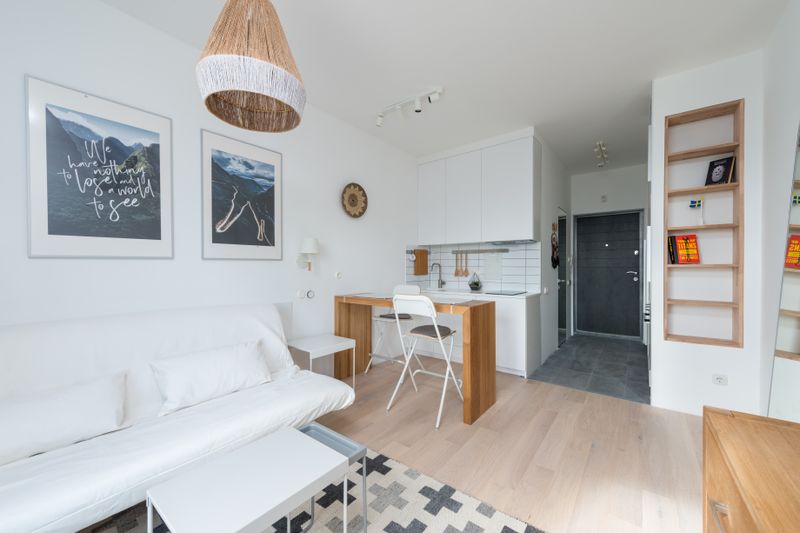
Both approaches to doors work. What differs is what they cost you, and the cost is what this sets out.
The difference in one place
- A standard door sweeps roughly one and a half square metres of unusable floor.
- Sliding and pocket doors trade floor area for wall area.
- Door position affects how furniture can be arranged in the room.
The swept area is real floor
A door around eight hundred millimetres wide sweeps a quarter circle of roughly half a square metre, and nothing can permanently occupy it. Add the clear space needed in front of it and the effective loss is larger again. In a flat with six or seven internal doors, that adds up to more area than a small bathroom.
Nobody draws this on a plan, which is why furniture arrives and then does not fit.
Which way it opens matters more than people think
A door opening against a wall protects the room, screens the view in and leaves the wall behind it usable. A door opening into the middle of a room, or towards the window, cuts the space in half and blocks the most valuable wall.
Changing the hinge side is a modest joinery job and often the highest-value change available in a small flat. Doors should generally open into the less-used space and away from the main furniture wall.
Sliding, pocket and folding
A pocket door disappears into the wall and reclaims the entire swept area, at the cost of losing that wall for fixings, sockets and pipes. A surface-mounted sliding door needs a clear wall to slide along and is far simpler to retrofit than a pocket. Bi-fold and concertina doors take less space than hinged doors and have more hardware to go wrong and worse sound insulation.
Sliding doors of any kind seal poorly, so they are a poor choice where sound or smell separation matters, such as a bathroom off a bedroom.
Removing doors entirely
Many internal doors do nothing but occupy space, particularly between a hallway and a living room in a small flat. An open doorway, a cased opening or a curtain restores flow and light for very little money. Doors that must stay are the ones serving fire compartmentation, sound separation, smells and privacy, and in many countries doors onto escape routes are a regulatory requirement.
Before removing any door, check whether it is a fire door and what your local regulations require, especially in flats.
Clearances that get forgotten
A door needs to open past a light switch, a radiator, a towel rail and any furniture, and it needs a handle that clears an adjacent wall. Two doors that clash when both are open is a common plan error in tight hallways and is fixed by changing one hinge side.
An outward-opening bathroom door in a narrow corridor can block the corridor entirely, which is worth checking before deciding. A door that hits a wall damages both, which is why a stop or a buffer is a five-minute fix that saves years of repair.
Budgets and buildings differ, and old buildings differ most.
Doors as objects
A tall door makes a room feel taller and a wide one makes a doorway feel generous, and both cost little more than a standard size at the point of ordering. A solid-core door sounds and feels substantially better than a hollow one and provides real sound reduction between rooms. Painting doors and frames the wall colour makes a small hallway read as one surface rather than a series of interruptions.
Underneath it, good ironmongery is the part of a door you touch every day and is worth disproportionate attention.
Side by side
| Consideration | What it means in practice |
|---|---|
| The swept area is real floor | A standard door sweeps roughly one and a half square metres of unusable floor. |
| Which way it opens matters more than people think | Sliding and pocket doors trade floor area for wall area. |
| Sliding, pocket and folding | Door position affects how furniture can be arranged in the room. |
The takeaway
Look at which way each door swings, change the hinge side where it wastes a wall, and remove the ones doing nothing.
The best rooms look like a decision, not a purchase.
Questions readers ask
Is a pocket door worth it?
It reclaims real floor area and is excellent in tight bathrooms and utility spaces. The costs are a wall you cannot fix into, poorer sound insulation and a mechanism that is awkward to service.
Can I take internal doors off?
Often yes, but check first whether any are fire doors or serve a protected escape route, which is common in flats and in houses of three or more storeys. Rules vary by country.