Small Spaces
The bulky things you own decide how small a home can be
Bikes, suitcases, prams and sports kit are what actually break a small flat, and none of them fit in a drawer.
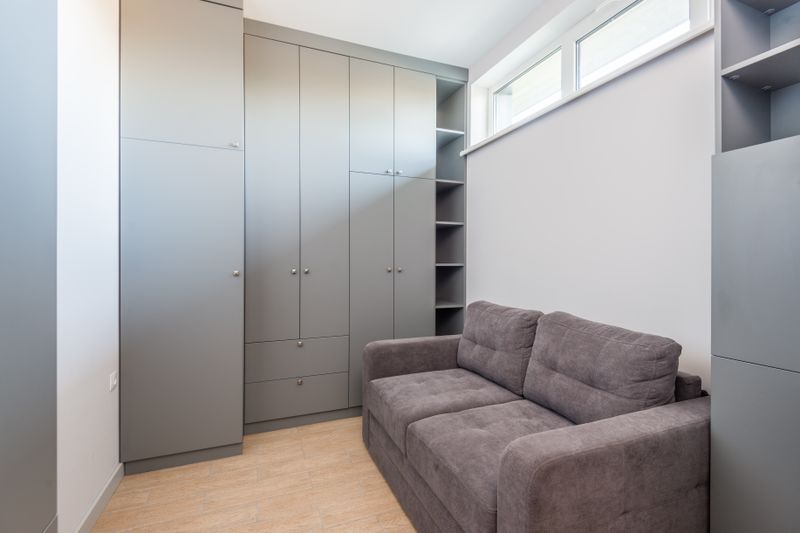
What follows is the working version of bulky storage: the decisions in the order you actually meet them, with the reasoning attached.
Before you start
- A handful of large objects consume more space than everything else combined.
- Vertical and above-head storage is where bulky items belong.
- Some categories are better hired or shared than owned.
A few objects dominate the problem
A bicycle, a suitcase, a pushchair, a folding table and a set of sports equipment together take more volume than the contents of a wardrobe. They are also awkward shapes that do not stack, which means they occupy far more space than their volume suggests. Small-space advice concentrates on small things, which is why it fails for the people who most need it.
Listing your genuinely bulky items and finding a place for each of them is a more useful exercise than any decluttering method.
Bicycles are the hardest case
A bike in a hallway blocks the route through a flat and gets damaged and resented, which is the standard outcome. Wall and ceiling mounts move it out of the circulation path and are the only arrangement that works long term in a corridor.
Underneath it, they need fixing into something structural, which in a rental means asking permission and using a fixing appropriate to the wall. Communal bike stores, secure outdoor lockers and paid bike parking exist in many cities and are worth the modest cost.
Use the volume above head height
The band between about two metres and the ceiling exists in every room and is almost always empty. A high shelf around a hallway or a run of cupboards above a door holds suitcases, seasonal bedding and boxed items out of the visual field. Anything stored there should be genuinely infrequent, because retrieving it requires a step.
The quieter point is that this is the single largest untapped storage volume in most flats and it costs a shelf.
Nesting and hollow objects
Suitcases should never be stored empty, because a large case is a container and storing air in it is a waste of the volume it takes. Winter bedding, coats and off-season clothes fit inside luggage and inside each other. Vacuum bags reduce the volume of soft goods substantially, at the cost of creasing and of a bag that is heavier than it looks.
Hard-sided cases nest inside one another if bought as a set, which is a practical argument for matching luggage.
Not owning is a legitimate strategy
Tools used twice a year, camping equipment, a spare table and specialist sports kit can often be hired, borrowed or shared more cheaply than stored. Tool libraries, equipment hire and neighbourhood lending schemes exist in many places and are underused. The honest calculation includes the value of the space the item occupies, which in a city flat is not trivial.
Underneath it, for items used weekly the arithmetic goes the other way, and owning is clearly correct.
Budgets and buildings differ, and old buildings differ most.
Paid storage and when it makes sense
External storage units cost a recurring fee that adds up quickly and often ends up holding things nobody will ever retrieve. They make sense for a defined period — between homes, during work, or while a decision is pending — and rarely as a permanent arrangement.
Over years, setting a date to review the contents, and being honest about what is being deferred, prevents an indefinite subscription. A useful test is whether you could name the contents of the unit without looking.
The takeaway
List the bulky things, give each one a home above head height or on a wall, and stop storing air inside your suitcases.
The best rooms look like a decision, not a purchase.
Questions readers ask
Where should a bike go in a small flat?
On a wall or ceiling mount out of the circulation route, or in secure storage outside the flat. On the floor of a hallway it will block the route and get damaged.
Is paid self-storage worth it?
For a defined period between homes or during work, yes. As a permanent arrangement it usually costs more over a few years than replacing the contents would.