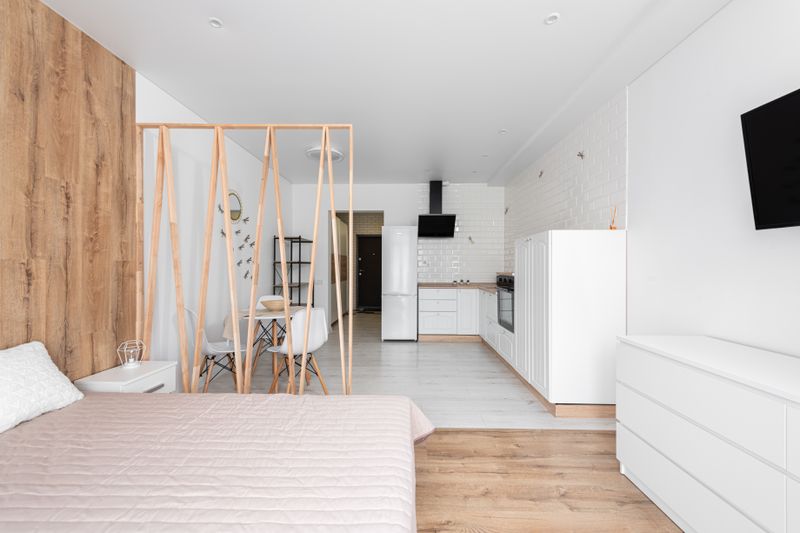
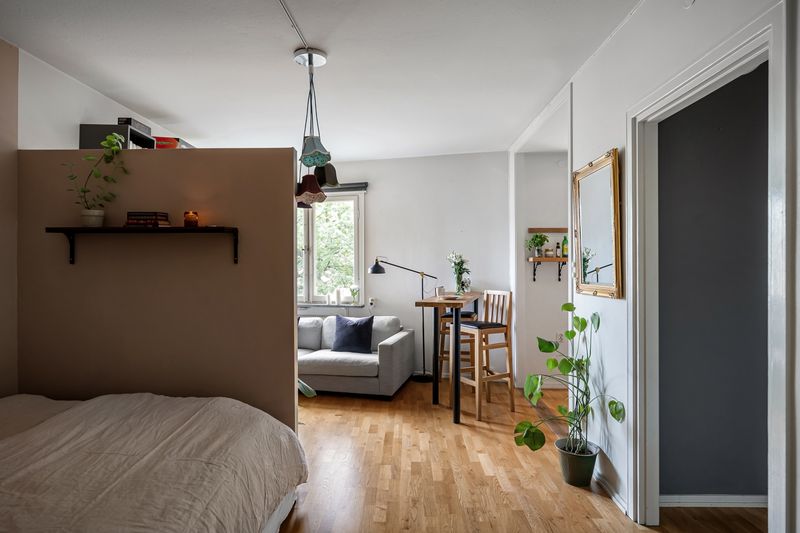
Small Spaces
Small rooms are not rescued by small furniture
The instinct in a tight room is to shrink everything in it. What usually results is a room full of undersized pieces that neither work properly nor look calm.
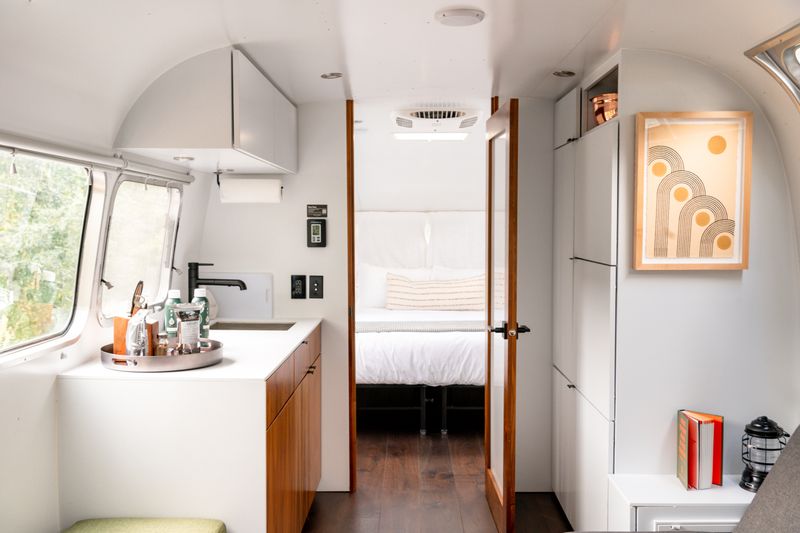
Everything below about furniture scale comes from what actually happens rather than from what is supposed to.
What holds up in practice
- Several small pieces produce more visual clutter than one larger piece.
- A room reads as larger when the floor is visible and the walls are uninterrupted.
- Depth matters more than width in a small room, because depth eats circulation.
Why lots of small things feel crowded
Every separate object creates edges, and the eye reads a room by counting edges, so eight small items feel busier than two large ones. Small pieces also tend to be shallow and light, so they end up scattered around the perimeter rather than establishing a clear arrangement. A single generous sofa often occupies less total footprint than a small sofa plus two chairs plus a side table.
The exception is anything that has to move, since a small room benefits from at least one piece that can be pulled about. The rule that survives testing is fewer objects, properly sized to their job, rather than everything shrunk proportionally.
Depth is the dimension that hurts
A deep piece of furniture pushes the circulation route further into the room, and circulation is what runs out first in a small space. A sofa that is slightly narrower but much shallower frequently transforms a room where the wider option would not fit at all. The same applies to desks, sideboards and dining tables, where losing a hundred millimetres of depth restores a usable route past them.
Manufacturers vary considerably in the depth of similar-looking pieces, so the specification matters more than the appearance. Measuring the depth of what you have and comparing it before buying is the step that prevents the most common mistake.
Legs, floor and visual weight
Furniture raised on legs allows the floor to run underneath, and a continuous visible floor is one of the strongest signals of size. Pieces that sit directly on the floor read as solid blocks, which can be right for a wall of storage and wrong for a small sitting room.
The quieter point is that slim arms and low backs reduce the apparent bulk of seating without reducing how comfortable it is to sit in. Transparent and reflective materials interrupt the eye less, which is why a glass-topped table can sit in a space a solid one would fill. These are perceptual effects rather than measurements, but they are consistent enough to design around.
Height, and using the wall properly
A tall narrow piece uses volume rather than floor, and volume is what a small room usually has spare. Storage taken to the ceiling reads as architecture rather than furniture, and the eye stops registering it as an object in the room.
In practice, a run of low units around a room, by contrast, cuts the wall at a single height and emphasises how short the walls are. Wall-hung pieces, from shelves to a floating desk, keep the floor clear and are limited only by the strength of the fixing.
Anything tall or wall-mounted has to be fixed properly into a structural element, and this is a safety matter rather than a preference.
One large gesture beats many small ones
A single oversized element, a big mirror, one large picture, one generous rug, gives a small room a focus and makes it feel considered. A wall of small framed pictures does the opposite, breaking the wall into fragments and drawing attention to its size.
Room to room, a rug that reaches under the front legs of the seating unifies the arrangement, while a small mat floating in the middle divides the floor. The same logic applies to pattern, where one bold use reads as intentional and many small patterns read as noise. Choosing where to be generous is a small-space skill, and it usually means being restrained everywhere else.
Testing before buying
Marking out the footprint of a piece on the floor with tape shows the circulation consequences that a measurement on paper hides. Cardboard mocked up to the height and depth of a piece reveals whether it blocks a sightline or a window. Checking the route in, through doorways, around a stair turn and past a radiator, prevents the delivery that cannot be got upstairs.
The quieter point is that modular and knock-down pieces solve the access problem and are worth seeking out in flats with tight stairs. The measurements that matter are the diagonal ones, since that is how furniture actually travels through a doorway.
The takeaway
Fewer pieces, shallower rather than narrower, raised off the floor, and one generous gesture to anchor it.
The best rooms look like a decision, not a purchase.
Questions readers ask
Should I buy a small sofa for a small room?
Buy a shallow one rather than a narrow one. Depth is what consumes circulation space, and a shallow full-length sofa usually works better than a compact two-seater plus chairs.
Does furniture on legs really make a room look bigger?
It lets the floor run visually beneath it, and continuous visible floor reads as more space. It is a perceptual effect, but a consistent one.