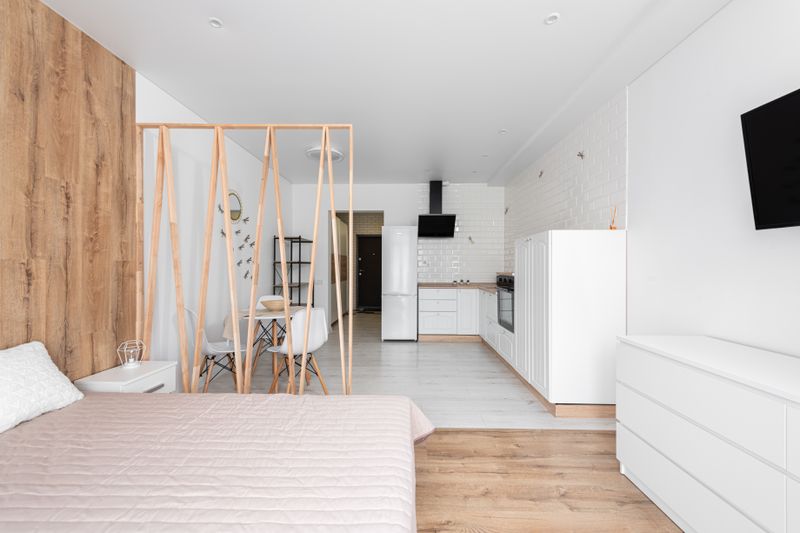
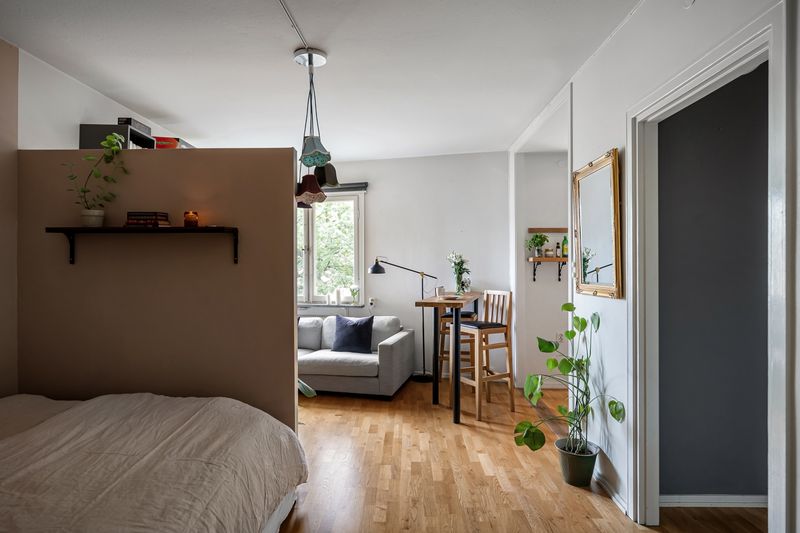
Small Spaces
A Small Room Heats Up And Cools Down Faster
Less air and less mass mean a small room responds quickly to sun, cooking and people, which makes comfort a question of ventilation and thermal mass rather than heating capacity.

Small rooms are usually described as easy to heat, and they are. The same property makes them uncomfortable in the other direction with very little provocation.
A small volume of air changes temperature quickly
Heating or cooling a room means changing the temperature of the air and the surfaces in it. A small room contains far less of both, so any input moves it faster.
The heat given off by people, a laptop, an oven or a shower is essentially fixed, and dividing it into a smaller volume produces a larger change.
That is why a studio warms noticeably while a meal is cooked and a large kitchen does not.
Sun through a window is concentrated
Solar gain depends on the glass area, not the room size, so a normal window in a small room delivers the same energy into much less space.
A west-facing studio can therefore become uncomfortable on a summer afternoon in a way that the same window in a large living room would not.
External shading, and closing blinds before the sun reaches the glass rather than after, are the effective responses.
Thermal mass slows the swing
Heavy materials absorb heat and release it slowly, damping the peaks. Concrete, masonry and tile all do this, while lightweight partitions and soft furnishings do very little.
An apartment in a masonry building rides through a hot day differently from a room framed in wood and lined with board.
Where mass cannot be added, the alternative is to remove heat before it accumulates, which means ventilation timed to the cooler part of the day.
Moisture builds faster too
The same logic applies to humidity, so a shower or drying laundry raises the moisture content of a small room to a level a larger one would absorb.
Condensation then appears on the coldest surface, which is usually a window reveal or an outside corner, and repeated wetting there is what leads to mold.
Extracting at the source, while the moisture is generated, deals with this better than airing the room afterward.
Equipment sized for the room, not the building
Oversized heating or cooling in a small room cycles rapidly, overshooting in both directions and never settling.
Smaller output running for longer holds a steadier temperature and, in cooling, removes more moisture from the air while it does so.
That is the argument for matching capacity to the actual room rather than assuming more output produces more comfort.
Questions readers ask
Can I put heavy planters on my balcony?
Only within its design load, which you will not know by looking. Wet soil is heavy, and in an older building the question belongs to a structural engineer and the building owner.
Why do my balcony plants keep dying?
Usually wind and drought rather than cold. Containers dry out fast in moving air, so use larger pots and choose plants adapted to exposure.