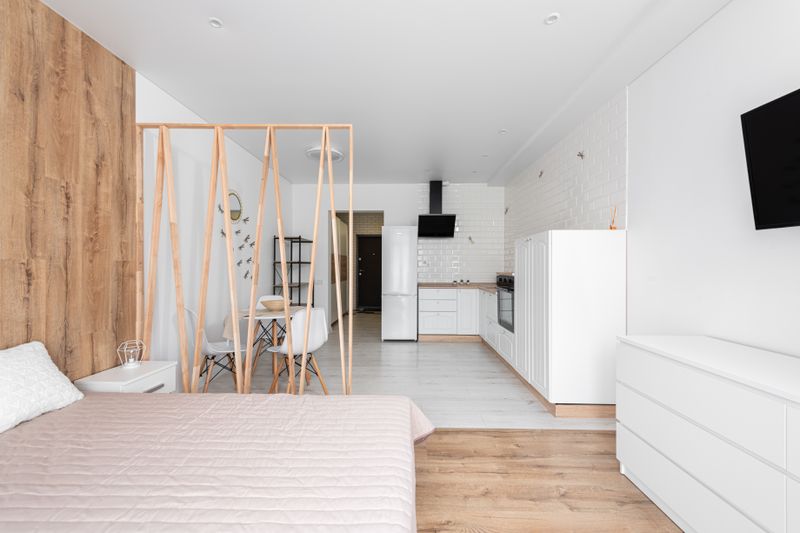
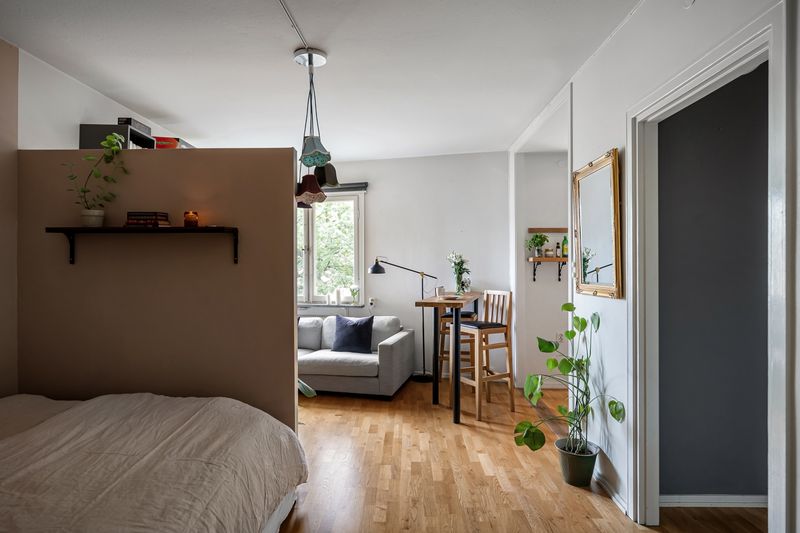
Small Spaces
Built-In Storage Buys Space That Freestanding Cannot
Fitted joinery uses the awkward volumes a freestanding cupboard has to ignore, which is why the same wall stores considerably more when it is built into.

In a small room the difference between fitted and freestanding storage is not appearance. It is the volume of the room that each one can actually reach.
Freestanding furniture leaves gaps by necessity
A cupboard is a rectangular box made to a standard size, and it sits in a room that is neither standard nor perfectly square.
The result is a gap at one side, a gap on top and a shadow of dead space behind, none of which store anything.
Across several pieces those losses accumulate into a meaningful fraction of a small room's floor area.
Fitted joinery works to the room as found
Built-in storage is made to the actual dimensions, including the out-of-square walls and the sloping ceiling that a manufactured unit cannot accommodate.
It reaches full height, so the top third of the wall becomes storage instead of a dust ledge above a wardrobe.
It also fills alcoves and recesses that no standard cupboard fits, and those are usually the parts of a small room that are otherwise unused.
Awkward volumes become useful
Under stairs, beneath window seats and into eaves are all spaces of irregular shape that hold a surprising quantity if the storage is shaped to them.
Shallow depth suits these positions, and shallow storage is easier to use than deep storage because nothing is hidden behind anything else.
The trade is that each of these is a one-off piece of work rather than a purchase, and cost follows accordingly.
Fitted storage is a commitment
Freestanding furniture moves with you and adapts as the household changes. Built-in joinery stays and is expensive to alter.
For a rented home that rules it out entirely, and for a house that may change use it argues for restraint about how much is fixed.
A useful compromise is fixing only where the space is genuinely awkward, and leaving the regular parts of the room to furniture that can move.
Doors are where fitted storage succeeds or fails
A hinged door needs clearance to swing, and in a narrow room that swing can occupy the entire circulation space.
Sliding and folding arrangements avoid the swing but always leave part of the opening obstructed, so access is never quite complete.
Choosing between them is a question about how often the storage is opened, and daily storage justifies the space a hinged door consumes.
Questions readers ask
Can I put heavy planters on my balcony?
Only within its design load, which you will not know by looking. Wet soil is heavy, and in an older building the question belongs to a structural engineer and the building owner.
Why do my balcony plants keep dying?
Usually wind and drought rather than cold. Containers dry out fast in moving air, so use larger pots and choose plants adapted to exposure.